The Raftsmen of the Ubaye and Beyond
Among the many lost river trades, that of the log raftsmen is one of the least known. The perceived opposition between mountain life and river navigation has contributed to the forgetting of what log rafting once was on Alpine rivers.
We — the rafting guides and kayakers — are far from the first to have tamed these torrential rivers. There was a time when mountain people had their own remarkable way of celebrating the river.
A Brief History of Log Raftsmen
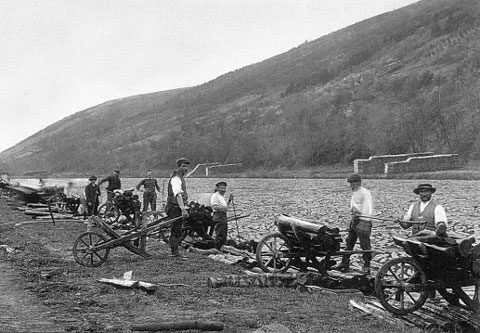
In 1775, archives record 40 raftsmen living in Volonne and 30 in La Bréole. By 1812, there were 15 raftsmen in Castellane, 14 in Forcalquier, and 16 in Barcelonnette!
From Antiquity, a deep bond formed between wood and water. Timber was buoyant and difficult to transport overland. Until the 19th century, the condition of paths and roads was very poor — even more so in the most remote valleys.
A telling anecdote from the Ubaye: given the still-disastrous state of the roads in 1844, a sub-prefect of Barcelonnette who wanted a carriage had it delivered in pieces — and could only use it within the town.
Two Types of Transport on the Rivers
— Loose-log floating. Cut and marked timber thrown loose into the current, drifting downstream.
— Raft floating. Built from a set of logs and steered by raftsmen.
Rivers and waterways, known as « roads that walk », unlocked many isolated valleys economically.
Today, this practice remains active in many regions of the world, such as Asia and Africa...
The Golden Age of Log Floating in France
The Seine–Yonne: fed by its tributaries, the Yonne and the Armançon transported firewood to Paris. Log floating on the Yonne was unrivalled among French rivers. From the 15th century, the Morvan was the main supplier of firewood for Parisians. The Yonne became a benchmark for this mode of transport — the economic organisation of the companies operating it and the many waterway improvements it required permanently shaped this river.
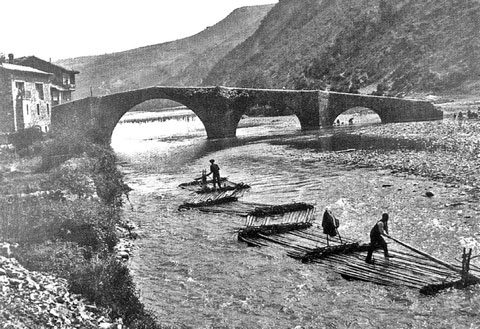
Around 1840, it carried 3,770 timber trains totalling 700,000 to 750,000 stères. These colossal figures reflect Paris's consumption at the end of the 18th century — an average of 1.5 million stères per year. Centuries of log floating fundamentally altered the geomorphology and hydrology of the rivers involved.
The Dordogne: It supplied Bordeaux with substantial quantities of merrains (oak staves for barrel-making).
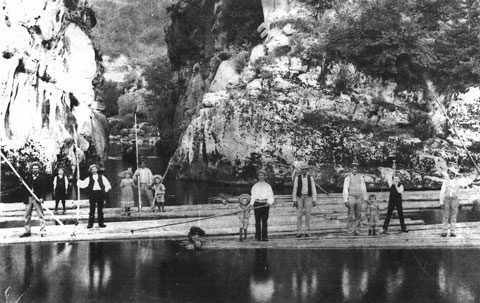
The Neste River from Saint-Lary: It transported naval mast timber and Aure marble down to the Garonne.
The Upper Aude: Here, loose logs floated from Axat, released into the river during floods. They were collected at Quillan and then assembled into rafts called carras. From Quillan, the carrassiers formed a train of rafts all the way to Trèbes to join the Canal du Midi.
The Rhône: With its many tributaries and sub-tributaries — the Bienne, the Saône, the Doubs, the Ain, the Isère, the Durance — the « river god » flowing into the Mediterranean was a major axis. It channelled high-quality timber from the Jura, the Vosges and the Alps into the heavy traffic of this resource.
The Durance: In 1888, with its 256 km open to rafts between Saint-Clément and its confluence with the Rhône, it was the longest « raftable » river in France. With a drop of 1,847 m, it was the third fastest river in France. Its destructive and unpredictable floods were particularly feared.
Before the major hydroelectric installations built between 1955 and 1992 to regulate its flow, its discharge varied from 50 m³/s at low water to 6,000 m³/s during floods.
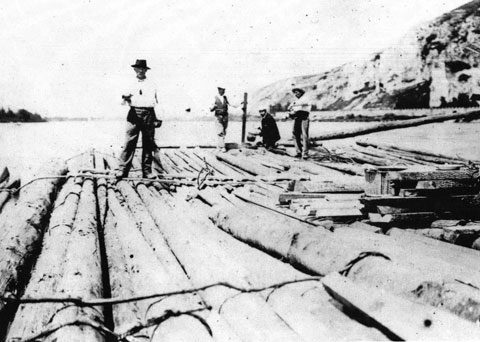
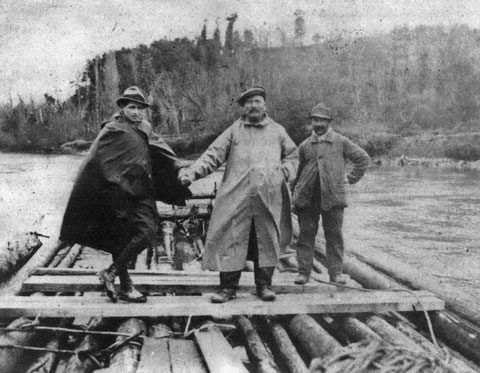
The Isère: Down to its confluence with the Rhône, it was « floatable » for 250 km from Aigueblanche below Moûtiers (Tarentaise). Then « raftable » for 200 km from the Combe de Savoie near Albertville.
The lower Guil: Its use as a navigable waterway is attested by the record of a raft accident in 1656, and also a raft theft in 1680 at this location.
The Alpes-Maritimes: No watercourse here allowed navigation. However, the Var, the Tinée, the Vésubie, the Estéron and the Roya served until the 19th century as valuable routes for transporting timber to the coast at Saint-Laurent-du-Var.
Rivers and Waterways: A Reliable Supply Chain
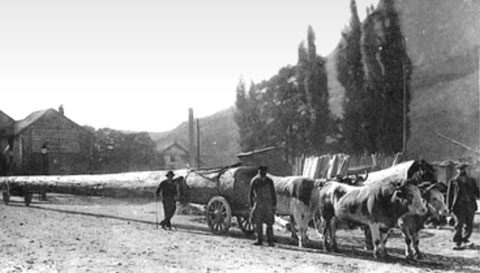
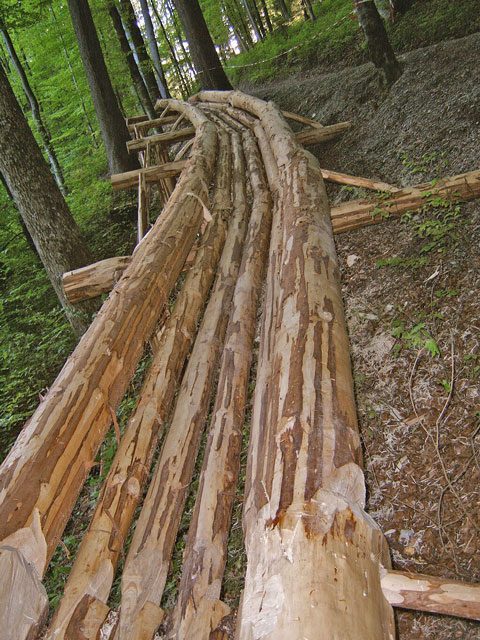
Insecurity, floods, rockfalls and erosion caused by storms penalised overland access. As a result, intense activity took place on the treacherous and unpredictable watercourses. It was thanks to the rivers that the exploitation of large forest massifs could develop. They provided an important source of income for rural communities.
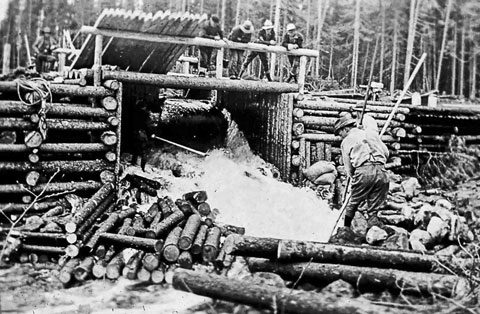
Extraction was extremely arduous. Logs were driven along mountain-side haulage tracks. The trunks were pulled by oxen or launched using log slides down to the river banks. For loose-log floating, the timber was propelled along torrent sections successively by sluice gates.
Timber, Always More Timber!
From the 12th and 13th centuries, cities consumed vast quantities of timber. For construction, structural wood and frameworks. Many needs existed in this pre-industrial era before coal was exploited.
- Energy and raw materials for industry: forges, joinery workshops, glassworks, paper mills, tile works.
- Mediterranean shipyards from the mid-17th century onwards. At Arles, Marseille, Martigues and Toulon. The Durance, with the forests of Boscodon between Embrun and Savines-le-Lac, of Clausonne near Serres, of Clara-Combres near Ribiers and of Durbon near Veynes, supplied fir for masts and rigging.
- The Queyras with the Ubaye supplied larch for the planking and decks of ships, as well as oars for the galleys.
- The Isère delivered to the Rhône rafts from the Tarentaise, the Val d'Arly, the Maurienne, the Chartreuse and the Vercors. Rich in conifer varieties, straight timber for masts and broadleaf species prized for « bent wood » needed for stems, floor timbers and futtocks.
A warship is a forest on water: a 74-gun vessel some 60 m in length required 2,500 trees. The construction of its masts demanded fir trees between 25 and 30 metres tall and 1 metre in diameter.
« France will perish for lack of timber! » — Colbert, minister under Louis XIV
Dependence on Scandinavian timber first pushed Richelieu, in 1629, to look at the forests of the Basque Country. Colbert, from 1665, prospected in distant forest massifs. The Haut-Forez, Auvergne, Béarn, the Aspe valley. The Allier and the Gaves became « mast roads ». By 1760, this entire economy built around forest resources had run dry.
Always Higher
Progress in logging techniques made it possible to reach naval timber around Mont Blanc. The upper Arve valley was « crowned with the finest mast timber in the Universe ».
Its quality matched that of northern timber. This wood kept for around twenty years at sea, while that from Auvergne lasted only 17 months.
A Large Fleet of Rafts on the Water
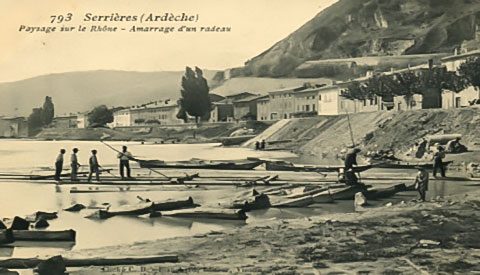
Raft navigation was concentrated in spring and autumn. Some figures to convey this traffic:
At Romans, in 1839, 1,028 timber rafts came downstream.
Upstream of Grenoble, between 1845 and 1850, some 11,000 tonnes of floated timber per year were estimated. Downstream, the figure reached 20,000 tonnes — a total annual flow of 950 rafts.
Log floating regulations required at least four rivermen per raft.
In most cases, the raftsman was also the merchant. The bulk of the raftsmen lived in the north of Haute-Provence. These forest workers, often raftsmen themselves, felled the trees in their local areas. Timber was hauled by ox-carts in dry or frosty weather. Log slides were also used to bring the trunks down to the river banks. The logs were sometimes wrapped in leaves and branches to protect them from damage as they slid to the water's edge.
Log Rafting: A True Art
The departure respected specific criteria. Floods of more than 1 m, but not overflowing, so as not to end up outside the river bed. The art of log floating required launching the rafts as the water rose — without always knowing how long the flow would remain sufficient. Some used a rain gauge to anticipate: filled in a given time by rainfall, it indicated that the river's flow would be favourable for at least 24 hours. It all depended, of course, on the size of the catchment area.
Conversely, if the rafts were unexpectedly blocked by a sudden drop in water levels and found themselves grounded, one had to wait for the next flood — to the detriment of the timber's fibre quality. Having to move quickly within the brief window favourable to navigation required clever solutions. One of the most ingenious techniques was that of the « banches » — lateral fir planks positioned along the sides of the raft. Fixed at the bow, they could swing outward upstream in a « scissor » action, allowing water to rush in and accelerate speed in the widest sections of the river. This clever device could also be used to free a grounded raft: the banches, swung open and caught by the current, would drag the raft free.
In certain regions, such as the Yonne basin, artificial floods were created. One could not rely on natural floods occurring irregularly. By creating artificial stretches of water along the watercourses and releasing them instantly, logs or rafts could be propelled downstream. These artificial lakes also allowed, by their extent, easier access to the timber resource, reducing overland transport. In the Alps, as in the Tinée valley, successive flash dams were also built in river beds. By opening them, « éclusées » or flushes of water were triggered to sweep the « loose logs » downstream.
Log floating was for a long time linked to the absence of overland access, certainly. But was it a last resort? Not necessarily, when one considers all the regulations and written protections put in place by the administration. On the contrary, the important and viable role of this mode of transport was well understood. The 1669 ordinance, the Forest Code of 1827 and the practical treaty on water policing of 1857 all attest to this.
Log Floating in the Ubaye
In the archives of Digne-les-Bains, Denis Furestier* found correspondence from 1847 between a civil engineer and the prefect of Basses-Alpes. These letters reveal the State's interest in improving log floating. Even as floating on the Durance was in decline, this correspondence speaks of a desire to make the Ubaye « raftable by rafts » in the Barcelonnette valley!
The prefect's report supported this, affirming the project was feasible at low cost. Apparently this work was never begun. As a river guide navigating the Ubaye by raft, one wonders: which sections of the Ubaye were they referring to — the lower reach (Roche Rousse to the Serre-Ponçon dam), the middle, or the upper?
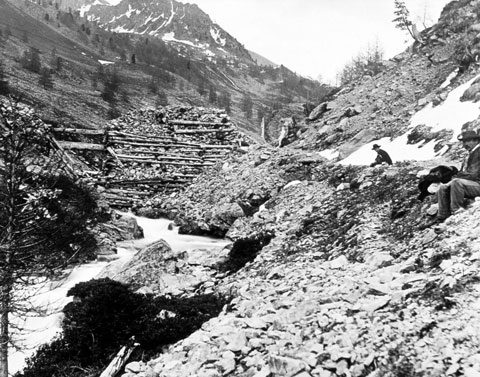
But given the engineering work carried out in Switzerland, in the Valais, to make the upper Rhône navigable by raft — it was conceivable to widen the narrows, smooth out the rapids and reduce obstacles to make the entire Ubaye raftable.
The project seems quite surprising given the rugged morphology of the Ubaye. Yet were we not crossing mountains and digging tunnels in those days...
The same archives mention that a request for log floating was made for the Bachelard, but the municipality of Uvernet-Fours never gave its approval.
The Raft: Timber's Self-Propelled Vehicle — and More
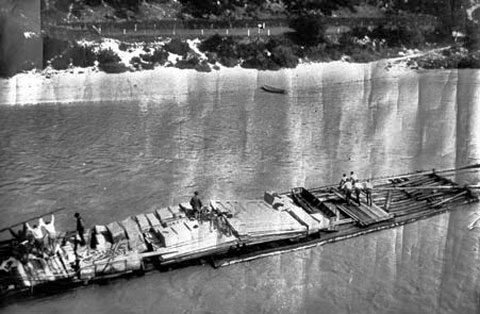
Timber rafts served as a self-propelled vehicle for the forest resource. But log floating had always also been used to bring goods downstream: ore, slates, marble and fine stone. Sometimes even passengers. After a dramatic incident in 1752, the Chamber of Waters and Forests of Aix-en-Provence issued a ruling regulating raft accidents.
Only the Navy, from the 18th century onwards, would impose on raftsmen the prohibition of carrying goods other than those addressed to them. It was the toll collectors who forced the Royal Navy's services to regulate the loads carried on their rafts. Being exempt from all toll taxes, the rivermen took advantage of this to carry supplies tax-free.
On the Isère, Navy rafts carried, among other things, raw pig iron from the blast furnaces of Allevard to the foundries of Saint-Gervais to produce Navy cannons. On the Rhône, this precious cargo continued its journey to the sea and to the various arsenals of Toulon and Marseille.
Tolls for Rafts
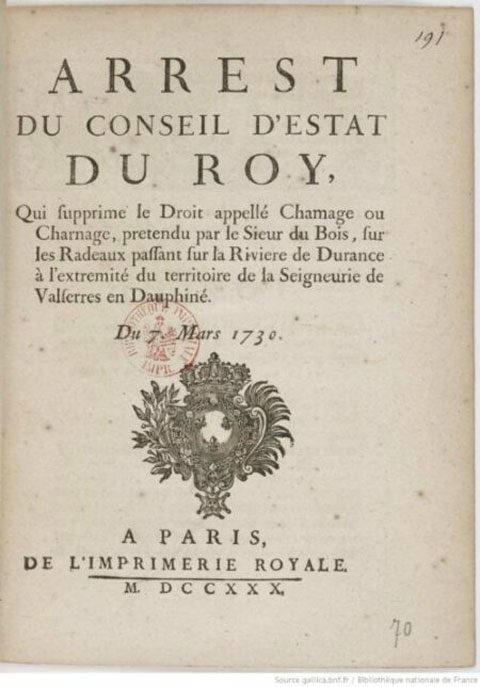
In the Middle Ages, the transport of numerous rafts along the rivers attracted local lords, secular and religious alike. By establishing tolls along the route, this provided them with a source of income. Towards the mid-18th century, the monarchy reclaimed most of the tolls and abolished several of them. The one on the Durance near Valserres, between Remollon and Tallard, was abolished by a Council of State ruling in 1730.
The Lost River Trades of Old
The « bateliers » or « nautes » transported passengers and freight.
The « radeliers » hauled timber down from the Alps.
The « naviculaires » linked the confluence of the Rhône and the Durance near Avignon to Mediterranean ports via the Rhône.
The
« utriculaires » crossed the shallow channels or delivered heavy freight on rafts fitted with inflated goat-skin bladders to improve their buoyancy.
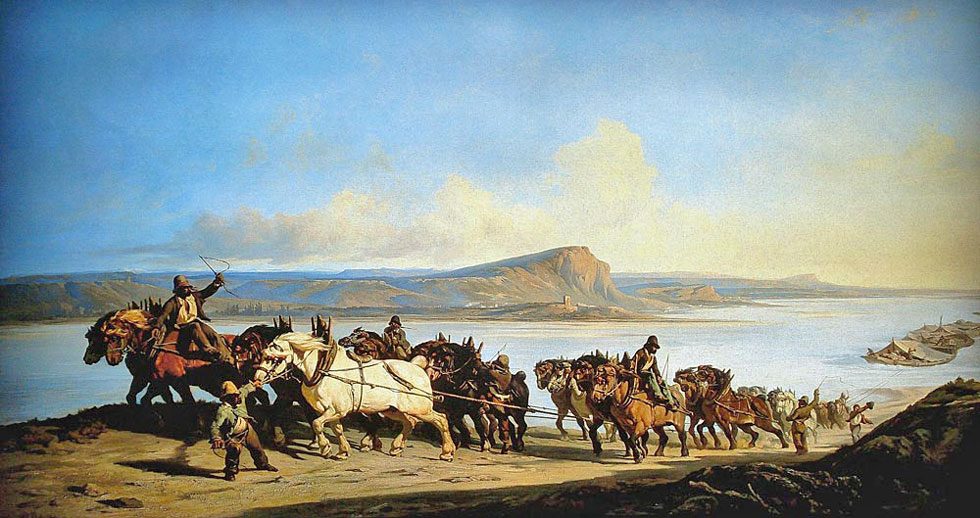
The « haleurs », assisted by draught animals, organised the « remonte » upstream. During the hot months, sails were raised in the southerly breeze.
The « passeurs » planned ferry crossings of the watercourse.
The
« receveurs » collected transport taxes on the river.
The Age of the « Lords of the River »
At the peak of river haulage in the 18th century, crews counted up to 90 horses to haul the vessels, while some fifty men were spread across the boats.
Bridge piers and confluences required the crossing of the watercourse; horses and rivermen were carried on the ferries.
Arles to Lyon: 20 days on the « remonte » upstream and three days on the way down.
From 1830, the appearance of steam-powered vessels and then the railway sounded the death knell for the crews. The « lords of the river » ceased to exist by the 20th century.
Building the Rafts
The trunks were placed side by side and bound together with plant-based ties. The narrower ends were placed at the front of the raft. The much lighter front section made the rafts more manoeuvrable.
Depending on local resources, different species were chosen to make the binding ties called « riortes », « lieures » or « harts ». In Catalonia or Italy, willow or young oak was used. On the Rhône, alder coppice shoots.
The Durance raftsmen today, during reconstructions, use hazel for these bindings. After cutting, the branch is soaked in water for about ten days. Crushed and twisted, the fibres are separated without being weakened. The branch becomes a flexible yet strong bond for tying knots.
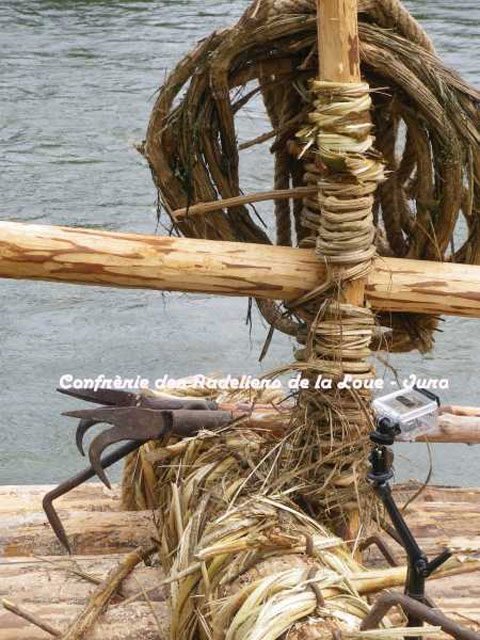
Photo Confrérie Saint-Nicolas des Radeliers de la Loue
Cross-beams placed at the ends of the raft stiffened the whole structure. Metal staples (clameaux) were sometimes used to strengthen the assembly. They can still occasionally be found embedded in old beams that once floated downstream.
The timber frames situated on both banks of the Rhône between Montélimar and Arles contain numerous archaeological traces of log floating. The ties that held the trunks together in the raft are still found in many pieces of timber. Cut through by the carpenters' work, these fragments protrude flush with the surface of the beams.
One or two rudders on long trunks, placed at bow and stern and resting on a frame to steer the raft. Poles, pikes or gaffs were used for departures and landings. These accessory elements were rarely used on the upper river beds. However, they proved very useful on the lower Durance during rapid recessions or calm sections with shallow draft.
Raft Dimensions
On the Isère in 1843, rafts could reach 24 m long by 9 m wide; departing from Savoy, regulations of the time limited their length to 18 metres and a width of 6 metres.
On the Durance, rafts were made essentially of fir and larch. Most were between 12 and 14 m long. Exceptionally, those destined for the masts of large ships reached 18 m with a diameter of 70 to 80 cm.
On the Rhône in the 14th and 15th centuries, four types of raft navigated:
- The raft proper was composed of several hundred pieces of timber
- The « musanche » was made up of 144 logs
- The « martela » of two to three dozen
- The « naviol » a little less.
Navigating on a Raft
Choosing the right moment for departure was of paramount importance for launching such vessels on the river. Too low a flood risked grounding the precious raft on a gravel bank for long weeks. Too high a flow made the passage under bridges, through structures and the manoeuvres dangerously unpredictable.
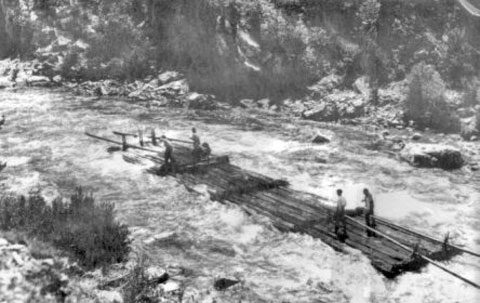
The raft was naturally propelled by the current, and only the men's manoeuvres guided the craft's positioning on the river. Given the weight of these vessels — between 15 and 20 tonnes unloaded — they generated a powerful and dangerous inertia. It was through the pilots' experience and anticipation that obstacles could be avoided.
A crew of 5 to 8 men had to control this navigation. With precarious balance, barefoot or in clogs, on a slippery surface, they did what was necessary.
The difference in morphology between the upper torrent section of the rivers and their lower meandering reaches demanded a certain versatility in the art of navigation from the raftsmen's crews.
The journey from Grenoble to Valence, depending on the speed of the current and without stops, could be completed in a single day.
From Eygliers, near Guillestre, to the royal bridge at Arles — 300 km — took 3 to 4 days in the best conditions.
The report of a civil engineer in the 19th century estimated that from La Bréole it took about 11 h to reach Sisteron. It took about ten hours to descend from Saint-Julien-en-Beauchêne (Haut Buëch) to Sisteron.
On arrival at the destination, the freight was unloaded and the raft dismantled, and the timber sold. The crew made their way home on foot, by bicycle or by stagecoach. They could also be engaged for the « remonte » on the haulage convoys. Salt, for example, was delivered to the high Alpine valleys for meat curing and to supply livestock.
Haulage Convoys on the Isère
Forty oxen per convoy to haul upstream on the Isère.
The upstream haul was organised in convoys of three or four boats linked together.
The total load did not exceed 150 tonnes.
The oxen were divided into two groups. The « cas d'avant » consisted of 24 oxen harnessed in pairs to a first « maille » — a tow rope attached to the lead boat. The « cas d'arrière » comprised 16 oxen harnessed to the « seconde maille » attached to the second or third boat. The length of these tow ropes was 100 metres.
The Dangers of the Trade
Steering and manoeuvring these extremely heavy craft was perilous in the extreme. In the rapids, the slightest loss of control could send the raft off its trajectory — broadside against an obstacle, wedged or even overturned by the current. The consequences were uncontrollable. There was no way to brake or moor safely, no safety measures at all. Not to mention that most of the rivermen could not swim. Buoyancy aids were unknown.
It was also the terror of other river users — those on the upstream haul, the haulage crews and the steam vessels. A threat too for structures along the river, such as mills and footbridge piers. On 20 March 1858, master raftsman Pierre Martel from La Bréole accidentally destroyed a piece of equipment belonging to the Ponts et Chaussées. He had to defend himself before the administration. A former raftsman, Antoine Marchand, a timber merchant from Saint-Vincent-les-Forts in the canton of Le Lauzet, came to the raftsman's defence. Drawing on his own experience, he attested to the difficulty of passing under the bridge near the confluence of the Buëch and the Durance.
« In high water, the Buëch carries the Durance's current directly onto the rock of Saint-Antoine, which deflects it straight onto the rock of the iron bridge, making it impossible to come back left before the bridge at Sisteron... »
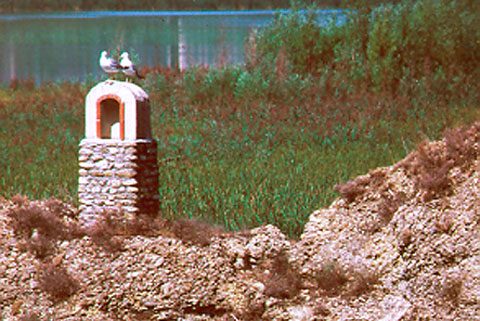
The harshness and constant risks of this trade were warded off by oracular shrines placed at the most dangerous passages. At Volonne, the bridge at Sisteron — among many others in times of flood — were perilous points to negotiate. Maintaining constant vigilance demanded great effort from the crew members. The rivermen braving the elements suffered from illness.
Giving Every Chance of Success
Sanctuaries marked the major hazards:
The Raftsmen's Oratory — Saint-Joseph — Volonne 04 was built in the 18th century to the north of l'Escale (at the confluence of the Durance and the Bléone) on one of the large exposed rocks. Erected as an ex-voto in 1700 by the guild of « Radeliers », this oratory stood on a rocky islet in the bed of the Durance. Submerged when the Escale dam was filled, it was rebuilt at the top of a cliff.
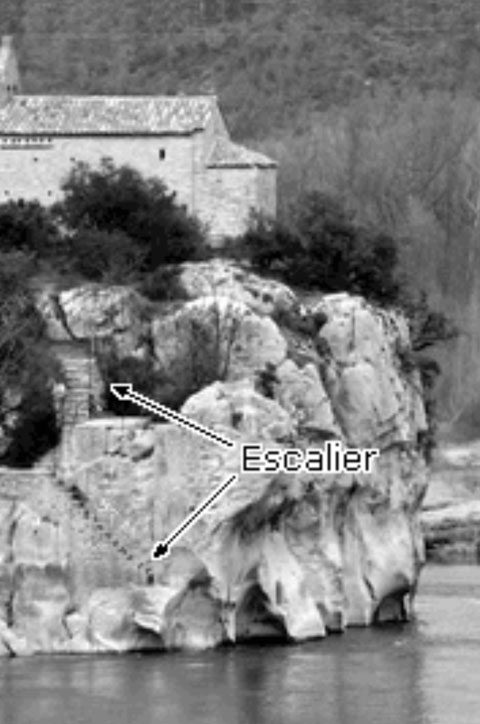
The chapel of Sainte-Madeleine, upstream of the bridge at Mirabeau, downstream of Saint-Paul-Lez-Durance, dates from the 11th century. The narrowing of the Canteperdrix gorge at this point created eddies and a strong acceleration of the current. This building was also known as « the chapel of the Raftsmen ». A staircase was cut into the rock specifically for them to provide direct access to the watercourse.
The End of Log Floating
The rise of industrial production, the emergence of the railway, road transport and the management of watercourses all contributed to the disappearance of log floating. It was, unfortunately, also the breaking of the bond between mountain people and the river.
In the Isère, recognised for its heavy raft traffic, the raft fleet declined with the construction of the railway from Saint-Pierre-d'Albigny to Albertville.
32 rafts in 1884 — 50 in 1885 — 10 in 1886 — 22 in 1887 — only 3 in 1888.
The construction of the electric dam at Beaumont-Monteux in 1921 and at Pizançon in 1931 (downstream and upstream of Romans) put a definitive end to navigation and raft floating on the Isère. It was on 27 July 1957 that the Isère was removed from the list of navigable rivers in France.
Furthermore, log floating was generating increasing complaints. In 1882, the commune of Breil-sur-Roya protested against the continuation of floating which caused damage during floods by destroying factory canals and considerably damaging properties. At the end of the 19th century, the practice of log floating gradually faded and quickly fell into disuse.
On the Durance, log rafting died out with the construction of the railway into the upper valley from 1850. The decline was long, and a few rafts were still spotted in 1918 and 1940 at the bridges of Le Lauzet and l'Archidiacre between Tallard and Remollon (testimonies of M. Bosse Elier — La Bréole, April 1993 and M. Conilh René — Les Mées, September 1996).
These rafts still had a transport role during wartime. The trade had already disappeared — set aside for technological and economic reasons. Erased from memory too, through historical amnesia.
This log floating activity, via the Durance and the Isère, was a socio-economic reality between sea and mountain. It will remain a vector of modernity for the services it provided to pre-industrial development. It is an epic chapter in the evolution of transport.
Even as log floating was declining as a global energy supply in Europe, the development of paper manufacturing from wood pulp gave it a second wind. In the Scandinavian countries, major exporters of pulp or sawn timber, it began to be practised on a large scale. Nevertheless, rivers such as the Yonne supplied firewood by floating until 1923.
Log floating was of course widely adopted in Québec and the depths of western Canada. Across the Atlantic, through this new pulp and paper industry, log floating for this new generation developed on an entirely different scale.
The Age of the Cageux (1806–1911)
« Where the cageux stop, villages rise »
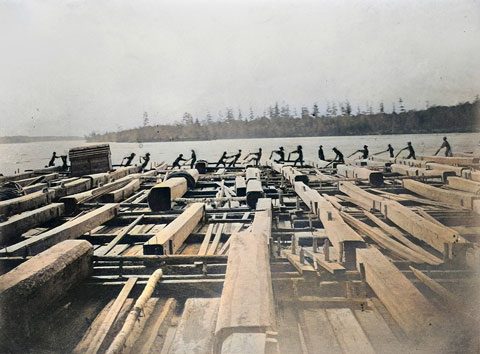
The cageux, the « raftsmen », navigated on large craft called cages. These rafts, made of squared timber logs bound side by side and end to end, formed the cage or timber raft.
They measured from 300 m to 500 m long and 60 m wide.
When wind and currents were favourable, the cageux helped themselves by fixing several square sails to the masts. In the descent of the rapids, they tied themselves to these masts to escape drowning. Like those at Lachine near Montréal, run today by kayakers.
Recognised for their great navigational experience, it was Indigenous women and their companions from the village of Kahnawake who came alongside the cages in their canoes. More than a hundred Mohawks took charge of the cage to guide it through the Lachine rapids. The cage was divided into five rafts of twenty-four paddlers, twelve at the bow and twelve at the stern. A giant known as Jean-Baptiste Canadien, called Big John, was one of their number.
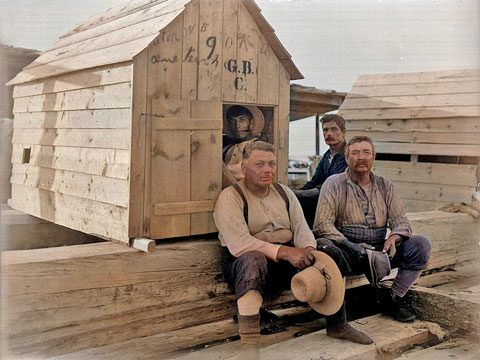
These craft were created for one reason: to prevent the loss of oak logs which, due to their density, sank. Bound to pine logs that floated, the problem was solved.
The cageux, on their true floating islands, sailed from Kingston along the Saint Lawrence. And also from Hull along the Ottawa River. Their final destination: the port of Québec, 500 km away.
This precious timber was then shipped to England by sea for the construction of the English fleet.
The history of the log drive in Québec is widely documented. But that of pine log cage floating around 1800 is not the same as that of pitoune driving in 1900. And yet it is one of the most emblematic episodes of the New World. Jules Verne drew inspiration from it in two of his novels: La Jangada (1881) and Famille Sans Nom (1888).
Benson's Cigar Raft in the United States
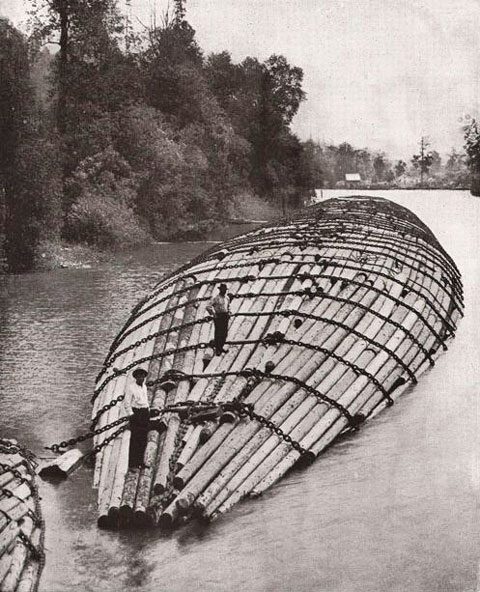
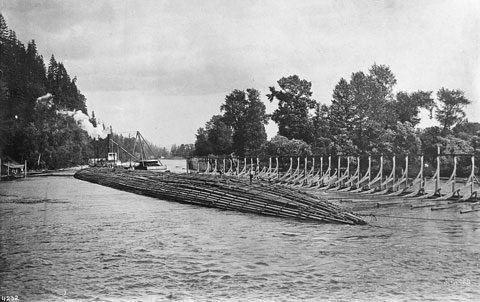
Highly specific to the United States, log floating was adapted for maritime navigation. First used on the Pacific coast in 1906 by Simon Benson in Portland, Oregon. Made of 24,000 logs, measuring 17 metres wide by 200 metres long. It required 70 km of cables and chains. They weighed up to 15,000 t. Like a wooden iceberg, two thirds of the timber were submerged. Six men steered this colossus, towed by very powerful tugboats, the Underwriter and the Ocean King. Highly profitable — it would have taken 45 schooners to fill the same volume.
To assemble this enormous cigar of timber, the floaters used a « ber ». It served to position and bind the pieces of wood. Then one side of the ber folded down to slide the raft into the water.
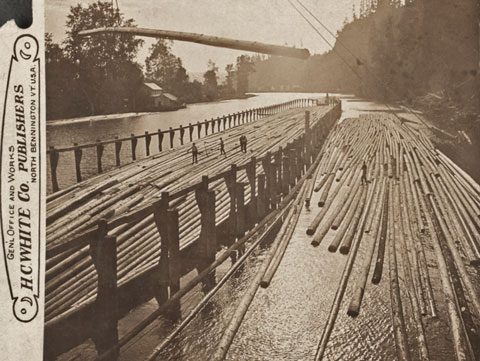
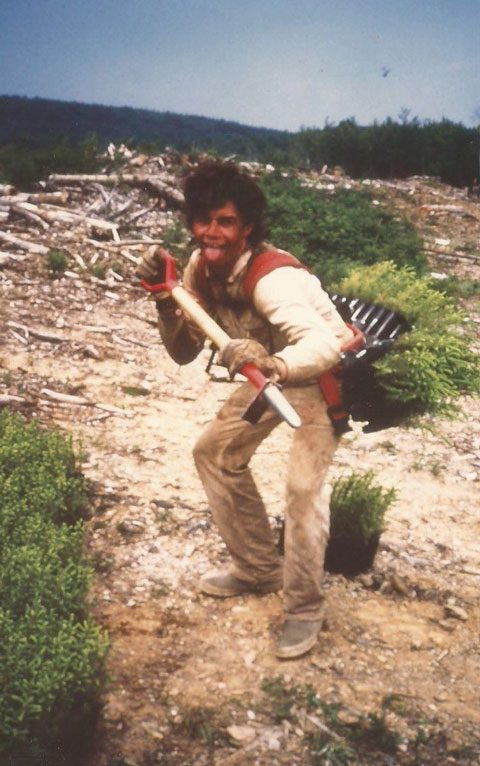
(P.L.)
In the 1970s, parasite attacks such as the « spruce budworm » decimated entire forests. This was the beginning of large non-selective machines that felled even the smallest trees. The era of clear-cutting had arrived. The conclusion was stark. The forest is not eternal. La Belle Province had no choice but to adopt a new relationship with its main resource. In 1983, the Québec government launched alone the first massive reforestation programme. By 1986, every forestry operator was required to replant. « One tree cut, one tree planted ».
Pulpwood Highways
Pitounes — four-foot (1.20 m) sections of wood, easy to handle, human-scale. They first circulated on Québec's first transport routes, the rivers of the Beauce, the Mauricie and the Outaouais, to supply the pulp and paper mills.
In spring, after the winter's logging, intrepid woodsmen took charge of launching the « pitounes » onto the waters. Armed with poles they dislodged log jams — the « jam » — to keep them moving.
Armed with gaffs, balancing on a floating pitoune, the log drivers were the unsung heroes of the era. From 1920 to 1960, paper manufacturing saw considerable growth. In 1957, Canadian production represented 77% of world newsprint exports.
But for generations of Québécois, the pitoune was a landscape, a livelihood, a way of life... Supplementary income passed from father to son for private owners of small woodland plots.
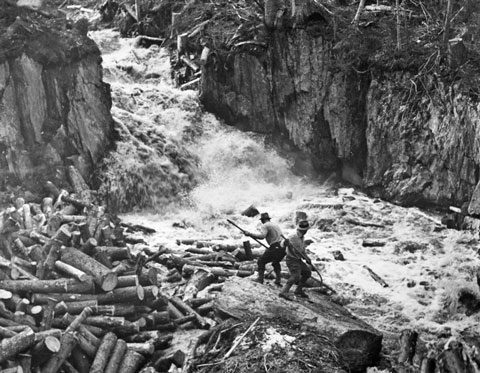
The End of the Log Drive in Québec
It was outdoor activity enthusiasts and ecological groups, joined by pleasure boaters, riverside residents, hunters, fishermen and biologists, who in the 1970s rose up against log floating. With the growing tourism industry, governments came to understand the importance of preserving and freeing rivers and lakes from log floating and the log drive. The crisis in the pulp and paper economy, the closure of many paper mills and technological innovations reduced the need for raw timber. These factors pushed operators to cease floating. A gradual abandonment from 1976, and more widely across most regions in the 1990s. Activity abandoned in 1976 on Lac Saint-Jean, 1992 on the Ottawa River, 1993 on the Rivière du Lièvre.
The Beauce region completed its last pitoune journey at the end of 2018 to the Wayagamack mill of Kruger in Trois-Rivières.
River Improvements for Log Floating
To imagine the organisation of this entire economy, it is instructive to look towards the New World. All this activity around timber transport by floating was known as the « drave ». These log drivers of European origin developed techniques imported over several decades. A human undertaking which, on our continent, had taken centuries.
According to the natural characteristics of the rivers (gradient, width, alignment, discharge and regime), various improvements had to be invented. Log floating had to overcome obstacles and improve flow that was too weak to carry timber downstream.
« River improvements for log floating, from upstream to downstream: transport types and structure types; the letters refer to the descriptions in the text below. Summary based on various works cited in the text (DAO N. Jacob-Rousseau). »
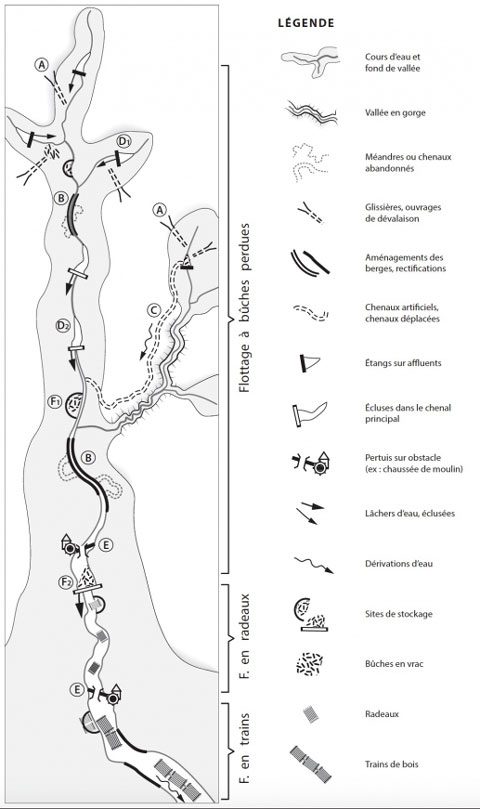
- (A) upstream, structures made of wood and cut from rock, designed to direct timber extracted from the logging sites towards the rivers: log chutes, log slides (Québec)
- (B) the modification of banks and channels (jetties, dikes, riprap) to increase speed and prevent log jam build-up
- (C) diversions, artificial channels or true lateral canals, enabling timber to be transported by bypassing certain sections of the natural bed or by diverting it
- (D) reservoirs to trigger water releases (« flots »,
« courues », splashing...)
to increase a natural flow too weak for timber transport:
- (D1) natural or artificial bodies of water located in valleys or on young tributaries of the main watercourse. Water was periodically released through an opening to create flushes increasing the flow of the main river downstream.
- (D2) timber or masonry sluices built in the channel. They retained floated timber as well as a volume of natural flow. When the quantity of timber and water stored upstream was sufficient, the « éclusées » — sluice releases — took place.
- (E) improvements to protect certain structures or to facilitate log flow more easily, also used to overcome certain natural obstacles. Log chutes and sluice gates were installed.
- (F) timber storage areas, either:
- (F1) on the banks, such as the « ports » of the Yonne
- (F2) held in the watercourse such as the « sidoli » of the Cadore (Italy, Veneto) or the « boom dam » of Oregon
A Modern Tribute to the Raftsmen of Old
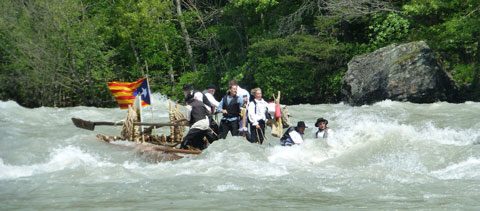
In 1993, the Association des Radeliers de la Durance was founded in Embrun in the Hautes-Alpes. Each year since, it has recreated the construction and descent of several rafts between l'Argentière and Embrun at the mouth of the Durance on the Serre-Ponçon lake. It is a living tribute and recognition of the raftsmen and their trades. Founded under the impetus of its President D. Furestier, the association has also taken on the duty of historical and scientific research into the log floating practices of old on the Durance.
A trade that has been all but gone for nearly a century. Oral memory had practically died out. The Durance itself had of course been transformed by the many hydroelectric installations. This revival was achieved thanks to advice from associations of Italian raftsmen (concentrated on the Piave and the Adige, and generally in the Italian Dolomites). And above all from Spanish ones (the Gallego in Aragon, the Cinca and the Pallaresa in Catalonia). They had never truly broken with the practice of this traditional activity.
A first event on the Durance took place in June 1994 and was met with great emotion. Though the descent by these still-inexperienced new raftsmen did not complete the full course.
The difficulties in recovering the technical skills needed for building and navigating the rafts were gradually overcome. Farmers, woodcutters, carpenters — some in their eighties — all came together to demonstrate how to work with wood. River guides practicing rafting on the Durance, such as Gérard Champoiral, also contributed their knowledge of currents, obstacles and the lines to take on the river.
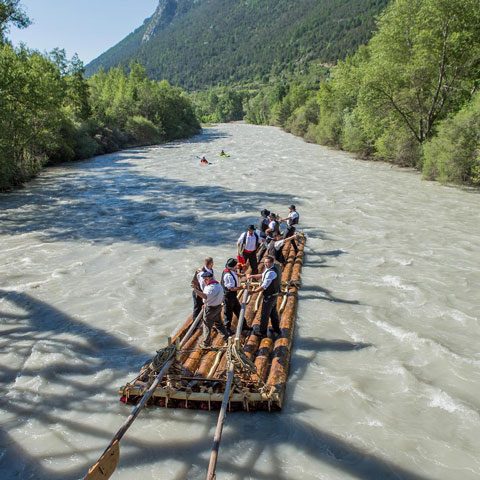
Annual Gathering of the Durance Raftsmen
Each year in late May, theAssociation des Radeliers de la Durance organises the descent of the Durance between l'Argentière-la-Bessée and Embrun. A unique event, open to all, where historical recreation and conviviality come together on the water.
Our rafting colleagues on the Durance offer to accompany this wild river adventure — don't hesitate to contact them for more information: white-water activities at Serre-Ponçon.
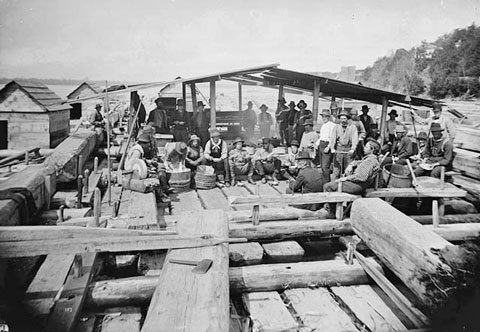
Log rafting, this millennia-old tradition, was listed in 2022 on the Intangible Cultural Heritage of Humanity by UNESCO.
The International Association of Log Floaters and Raftsmen was founded in Barcelona (Catalonia, Spain) on 11 November 1989. Its statutes were solemnly signed in Venice (Veneto, Italy) on 6 September 1992.
Information and dates: Serre-Ponçon Intercommunal Tourist Office
Bibliography
Immense thanks to all those whose precious contributions allow us today to speak of this wonderful epic!
- « Le Rhône. Un fleuve et des hommes » — Log floating on the Durance and the Isère past and
present. Édition Le Monde alpin et rhodanien — Regional ethnology review, 1999.
- Serge Fouilland — Centre for River Anthropology. Maison du Rhône, Givors and Université Lumière Lyon 2
- Denis Furestier, Founding President of theAssociation des Radeliers de la Durance — his publications: « Forêt et Marine », Andrée Corvol, L'Harmattan, 1999; « La Durance de long en large. Bacs, barques et radeaux dans l'histoire d'une rivière capricieuse », Les Alpes de Lumières, 2005; « le flottage en Haute Durance », Bulletin de la société d'étude des Hautes-Alpes (2011-2012); « Le flottage du bois en Europe, Techniques, sociétés et environnements », Presses Universitaires De Dijon, 2023
- « Le flottage du bois et le changement du paysage fluvial des montagnes françaises » — Jean-Paul Bravard. Édition Médiévales, 1999.
- « Le flottage du bois et ses conséquences écologiques, de l'Antiquité à l'époque contemporaine » — Nicolas Jacob-Rousseau, Frédéric Gob.
- Maison des cageux du fleuve Saint-Laurent — Isabelle Regout and Alexandre Pampalon
- « Le Fleuve qui nous emporte » — Novel by José Luis Sampedro (1961). Édition Métailié.
- « Le Seigneur du Fleuve » — Novel by Bernard Clavel. Édition Robert Laffont (1972).
- « Un été dans l'Ouest » — Novel by Philippe Labro (1988). Folio.
- Maison du Bois de Méolans
- Header drawing RAFTMAN — Microbrewery Unibroue
Also read: The Battle of the Rail in the Ubaye