Whitewater sports: a male-dominated world?
By Pierre Lafay, heavily rewritten by Rémi
The world of river descents is sometimes seen as male-dominated. That perception has statistical backing — but it says little about who actually excels at it.
Kayaking: it's invigorating!
In France, kayaking is mostly practised on fast-flowing mountain rivers. The water is cold and lively. It stays that way through your first capsizes too. Swimming alongside your kayak on one side and your paddle on the other can be pretty hardcore. Getting swept through currents outside your boat, scraping the riverbed with your backside or shins. You pick up knocks, collect bruises. Then comes the challenge of bailing 300 litres of water out of your kayak with numb fingers.
Portaging is the unavoidable physical reality of the sport. Every paddler must carry their boat — it's the entry fee for the activity. It's part of the game to reach put-in spots, and the way to bypass a rapid that's above your technical level. Kayak on the shoulder, difficulty avoided.
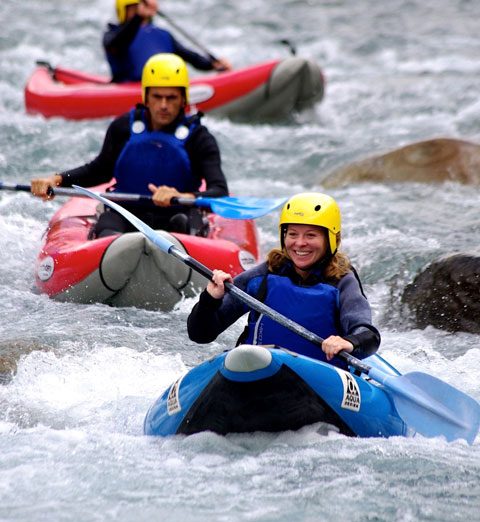
The boat itself isn't light. Outside of racing kayaks at around 7 kg, river kayaks for general or extreme use weigh around 25 kg. Taking up kayaking is comparable in every way to other outdoor pursuits — sailing, mountaineering, skiing, surfing. You constantly face natural and sometimes harsh climatic constraints.
No need to be Rambo
You don't need a removal-man's build to perform in a kayak. Quite the opposite: power, yes — but it's through finesse that the magic of glide happens. Small-framed kayakers performing at the highest level are numerous — Nouria, Jessica, Lynda, Aniol, Benny… have all run the most monstrous rapids and drops of over 30 m. Kayaking isn't the most gendered sport — girls and boys both wear the same skirt!
Women accounted for 29% of licence holders in the French Canoe-Kayak Federation in 2022.
Technique above all
Once past the initial rites of passage, great sensations come quickly. Gliding, riding waves and rollers, surfing, letting the current carry you. Discovering landscapes, meeting riverside communities, sharing moments rich in sensation as a team. That's also the role of the unsinkable inflatable craft that have been on offer for around forty years: a fast, fun introduction to river paddling.
The guide and their crews
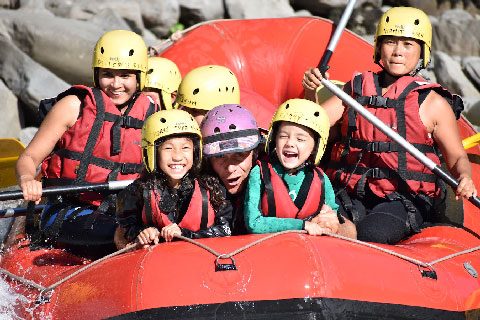
The rafting guide doesn't always choose their crew. They work with what they're given. Some, depending on conditions or their own capacity on the day, prefer a certain type of crew. The river professional adapts their navigation style to satisfy their group and ensure safety.
The dynamic is naturally different when your raft is made up of bikers, rugby players, or dancers. Nothing unusual about that — it's simply a matter of power-to-weight ratio and shared habits.
Quite frankly, for most experienced guides, the verdict is clear. Having women on board changes the dynamic. You instinctively shift toward a more technical approach, less focused on brute force.
So why does a female crew make a guide's life easier?
Team technique
Paddling as a team
Women know how to work together. They quickly understand why it matters, without needing to prove it. Before boarding, during the safety briefing, they're told: "you need to paddle together, everyone in sync!"
Women at the helm
Put two women at the front of the raft, and synchronisation will follow naturally. The crew falls into rhythm quickly. Without having to explain it twice, they grasp the value of paddling in sync. It increases the raft's power and glide. No need to "row" like a machine. Strength is collective!
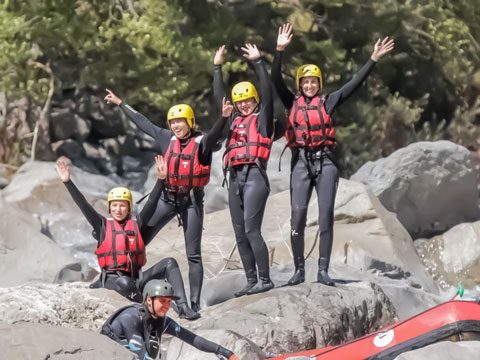
Competitive types at the front… as extras
Try the reverse with highly competitive crew members at the front. More often than not, it becomes a race between them. Placed at the bow, they try to out-paddle each other — effort turns into a personal duel rather than collective propulsion.
The right power-to-weight ratio
The power-to-weight ratio matters a great deal on a raft. A bodybuilder or heavily muscled rugby player won't generate enough energy to move all that mass efficiently. You accumulate moving weight rather than clean speed. By comparison, a lighter female paddler who is focused, with a full and perfectly timed paddle stroke, will outperform a heavy, less technical paddler.
"When you row, it's a grind. When you paddle, it's a joy."
The art of paddling
The art of paddling is about reaching that sensation of a clean, pleasant catch with the blade. It flows, thanks to collective synergy. It's also about finding a rhythm where the speed you generate allows a full, sweeping stroke. In sync, all together, you'll feel at the tip of your paddle the true pleasure of paddling.
Everyone is useful in a team… in the right position.
It's happened many times: when placing people in a mixed raft, we put two women at the front from the start. It never fails to make people think — and often triggers a conversion: spend a year lifting weights, and it's technique that wins. Of course, the best pedagogy is demonstration. Try it: two women at the front, then two men. With a lighter load at the bow, the boat glides and pivots more easily. Without a word, without a sound, everyone will feel it… "on this raft, the best way to paddle is definitely ours."
Managing effort from first to last rapid
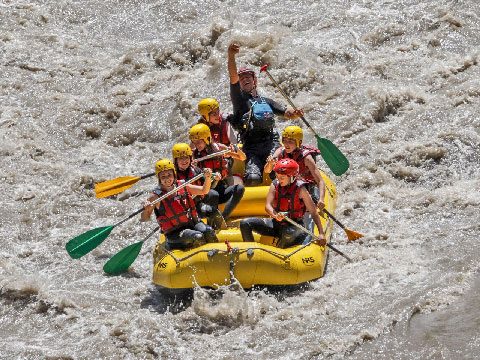
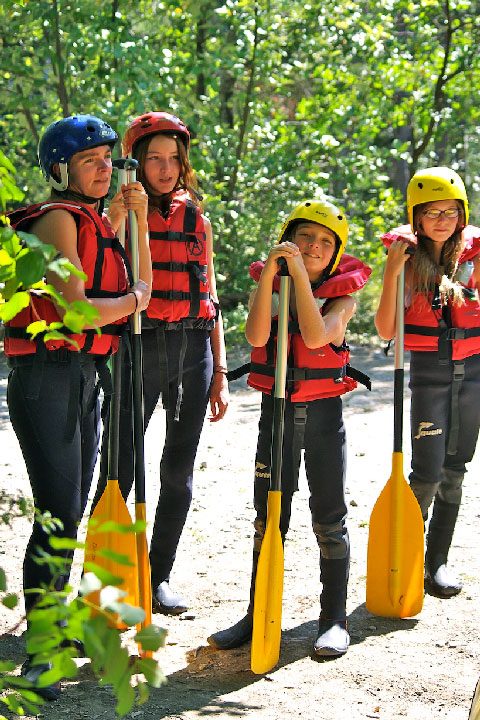
Managing the crew is first and foremost the guide's job. It's one of their many roles: conserving and optimising the crew's energy, from the start of the Ubaye raft descent to the finish. The boat needs proper propulsion — the guide's strength alone isn't enough to control navigation.
"Some crew members bet everything on brute force — and burn out fast."
Women paddle longer and more consistently. They know their limits without feeling the need to exceed them to impress. It happens very often that, among the male contingent, there's suddenly not much left in the tank halfway through.
Women listen and understand the importance of following advice. Paddling with more than just your arms lets you engage different muscle groups. By using your whole body with a precise position or movement, you avoid overworking any single muscle.
"Core engagement is what makes rafting a full-body workout!"
The one who "rows" like a machine hits the wall at halfway. The one who focuses on technique conserves their energy. Women apply themselves to good paddle technique: a deep catch at the front, short release at the back. No need to slap or lift water at the start and end of the stroke. By taking these precautions on board, women more easily keep their energy from the first rapid to the last.
Listening: the first asset on the river
Often encountering this environment for the first time, women tend to approach the activity without trying to dominate it — they observe, assess, then commit. The river can seem hostile, unfamiliar. They listen to the guide to decide whether trust can be established. Once reassured, they focus on following the instructions given, doing everything they can to respect them, to rise to the challenge they've set themselves. Women are always more attuned to what's happening around them.
On the water, you often notice a difference in approach: where some crew members leap into action — "paddle!" — others take the time to hear the full instruction before acting. That active listening changes everything about the quality of the navigation.
Feeling the river
When these first three elements align, harmony kicks in and the raft navigates as a crew. Results show, confidence builds. You can now enjoy the environment more fully and serenely.
"Art is a calling to which too many respond without having been called."
Directed paddle strokes
In some situations, you need to correct or noticeably redirect the raft to line it up properly for a rapid. Individual coaching can then go deeper to improve collective action, focusing on what are called "directed" strokes. Each person at their position triggers, through their action, a ripple effect across the whole raft. The paddle in the "draw" position is the perfect example. The person drawing on one side becomes the pivot point for the raft's rotation. Simultaneously on the opposite side, a sweep stroke is launched. And at the back on the draw side, a forward stroke. The simultaneous paddle movements of the crew members relieve and optimise the powerful pull of the draw. The art of navigating with pure glide.
"Little Grasshopper, the Great Wheel of Life is turned inexorably by the infinite stars. Be certain that truth cannot be deceived." — Master Po, Kung Fu.
Perrine on the front-left draw: her catch left the rest of the crew speechless. The guys use the right sweep motion in sync, but with a slightly light catch — not much blade in the water. The raft's rotation was largely achieved by Perrine's solid draw. Big up the girls!
Rafting with finesse
Having a capable, attentive, confident crew allows you to occasionally stop paddling and just drift. Let the current take you. Reach full awareness of your surroundings. Let the different currents act naturally on the boat. Use what the river offers. Spin, check speed by grazing an eddy. Embrace a rock then peel away from it. Settle gently onto the lip of a wave to read the line ahead. Attempt a tight ferry glide to tilt and lighten one side of the raft. A sideways slide, light as air, back-surfing in the hollow of a wave.
You must turn the opponent's power into a partner. With the kind of kinetic energy generated by the weight of a loaded raft and its crew, good effort management means exactly that.
Mindful on the river
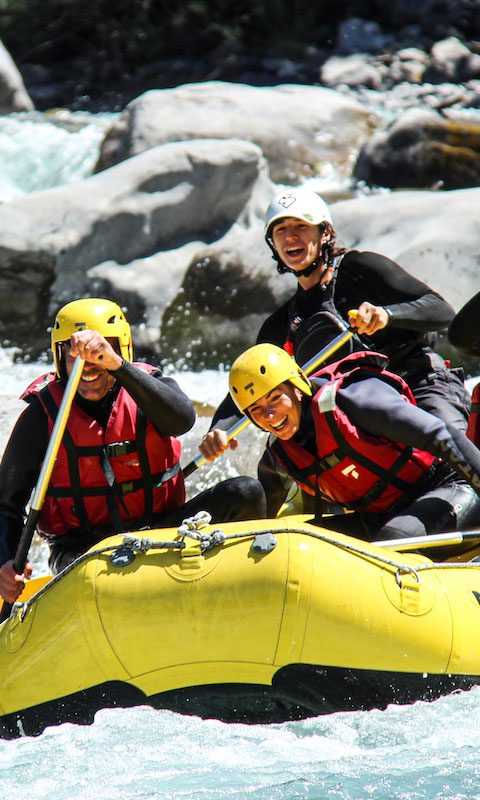
By reaching this balance, the rafting guide helps their crew experience those moments when the river feels like a companion. It's a chance to relax, take in the surroundings, feel the elements — competitive spirit set aside, stress dissolved in the current.
The message is clear: technique, listening, and teamwork make the difference — regardless of build or gender. Next time we meet, let's try to remember all these lessons. And remember: there are no bad crews without bad guides!
PS: the debate remains open — and the guys are welcome to defend their paddling honour on the Ubaye. Spoiler: we'll all be in the same boat.
Book a rafting session Learn more about rafting 🎁 Give rafting as a gift