The sacred bond with canoe and kayak
By Pierre Lafay
Before defining all these terms, it's worth a brief look at what canoe-kayak actually is — the foundation of paddle sports. These disciplines share the same family, the same environment, but very distinct practices, postures and cultures.
Kayak-raft, kaya-raft, cano-raft, canoë-raft, hot-dog, airboat, kayak-air, packraft… all of these terms refer to inflatable watercraft born from this world. To understand their specifics, a detour through the origins is in order.
The kayak
The kayak is paddled sitting down, with a double-blade paddle (two blades), usually solo, but in some disciplines with up to four paddlers (particularly in sprint racing).
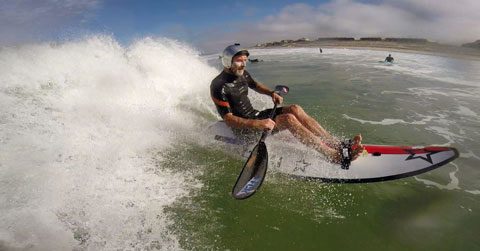
The open-deck kayak
You sit on top of the deck — a concept sometimes called sit on top. Your legs are visible outside the hull. These kayaks are generally self-bailing: water drains out by gravity without any input from the paddler. This type of craft appears in several disciplines:
- Sprint racing kayak — on flat water, an Olympic event.
- Recreational sit-on-top — sea, lake or easy river (Ardèche, Tarn, Drôme, Lac du Lauzet…).
- Surfski — known in France as Ocean-Racing — long-distance racing in a marine environment.
- Wave-ski — used to surf waves. AllWater in Mimizan (Line and Julien) is a fine example in France.
The closed-deck kayak
You slide your legs inside through an opening in the upper deck called a cockpit rim. This kayak is not self-bailing. A watertight seal is provided by the spray skirt — in neoprene or plastic — fitted around the cockpit rim and held at the paddler's waist. You are said to be skirted in.
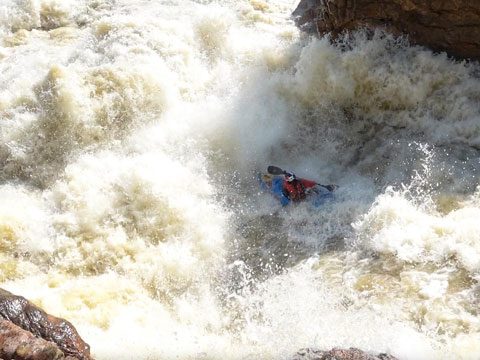
This is the architecture underlying the most technical disciplines:
- River kayak — slalom or wildwater racing.
- Freestyle kayak or extreme kayaking.
- Kayak surf — sometimes called a babouche.
- Kayak polo — a team sport with a ball and goals.
- Sea kayak — architecture inspired by the kayaks of the Inuit, indigenous peoples of the Arctic.
- Squirt boat — a low-volume craft enabling underwater moves; invented by Jim Snyder.
The canoe
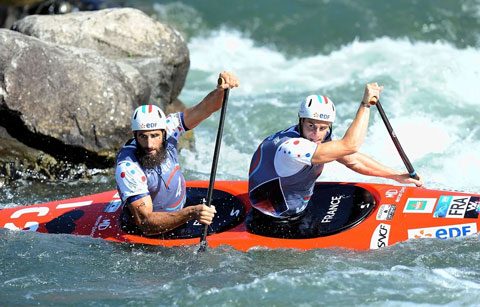
The canoe is paddled kneeling, with a single-blade paddle (one blade), most often with two paddlers, though also solo. The paddler kneels, strapped in, sitting on a thwart — a cross-beam along the hull axis — or a foam saddle. In competition, the deck is most often closed with a cockpit rim and spray skirt. Undoubtedly the discipline most familiar from film and literature.
Where to paddle a canoe?
For leisure, the most popular rivers in France are the Ardèche, Tarn, Orb, Hérault and Verdon. The craft are generally open, with a form derived from the Native American canoe.
In competition, the C2 river slalom canoe was long one of the most impressive disciplines in the family. It was an Olympic discipline for many years before being unfortunately removed from the world competition programme in 2018 by the International Federation.
The Open Canoe Festival
Every year, as spring awakens, Paul Villecourt and his team put on a magnificent event on the banks of the Drôme: theOpen Canoe Festival. In all its forms, it's above all the open canoe adapted to river descents of every difficulty grade. Its hallmark: more spatulate bows for easier pivoting, adapted internal equipment — inflated air bags — to avoid swamping in rapids, despite the open deck.
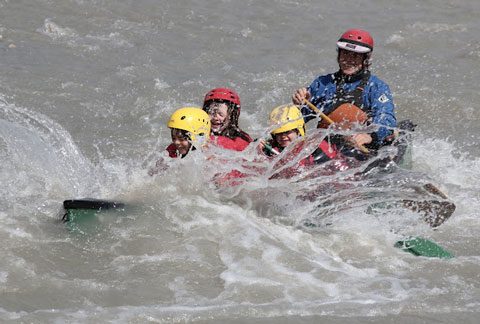
An event that pays magnificent tribute to open canoe culture, so often overshadowed by kayak in competitive disciplines.
Inflatable watercraft
Their common traits: inflatable and unsinkable structure, open deck without a spray skirt, self-bailing floor. Water that enters drains out by gravity directly into the river. Craft designed first and foremost for leisure — robust, stable, accessible with no prior experience, and far more forgiving in the event of a capsize.
All of these terms describe two main families:
- Solo — double-blade paddle: the kayak-raft (or kaya-raft), also known as kayak-air or airboat depending on the operator. You sit, using a double-blade paddle, just like in a kayak.
- Duo — single-blade paddle: the cano-raft (or canoë-raft), also called hot-dog. You paddle in pairs with a single-blade paddle, in the canoe tradition.
The terms airboat and hot-dog are sometimes used interchangeably by different operators to describe one or the other. As for the packraft, that's a different family altogether: a lightweight, compact inflatable craft designed for multi-day adventures.
Their limits in serious whitewater
These open-deck craft are excellent introductions to the river. They tolerate the classic beginner's mistakes — not forgiving of everything, but of a great deal. Their limits show up on serious challenges: on large class IV/V rapids with high water volume, these vessels quickly reach their ceiling. It's then preferable to paddle a closed-deck kayak, which allows an eskimo roll in the event of a capsize. Finding yourself ejected and having to swim in certain class IV/V rapids is a situation to avoid.
Learn more about the Ubaye river grading by section.
Of course, for those who want to progress and explore river technique in depth, the traditional kayak remains the queen of disciplines. Its performance and glide open the door to bigger rapids and the most beautiful rivers on the planet.
An American invention for the extreme
Fun — but not only…
It's worth knowing that the craft we call kayak-raft or airboat today were invented for quite different purposes. They originated in the United States, in Albright, a small Appalachian village in West Virginia, on the banks of Cheat Canyon.
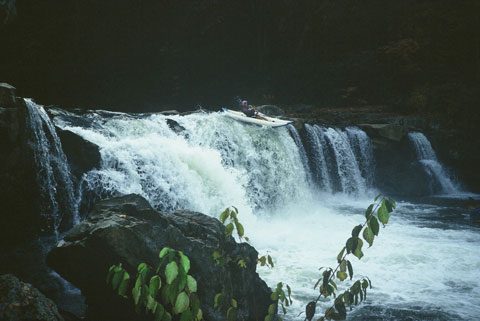
They're called Thrillseekers — invented in the 1980s by kayakers who use them frequently to open up new river sections in creek style: steep, winding, rocky waterways where the rock is close. The rock surfaces on slide rapids that run over bedrock slabs, as on the legendary Big Splat drop on the Big Sandy.
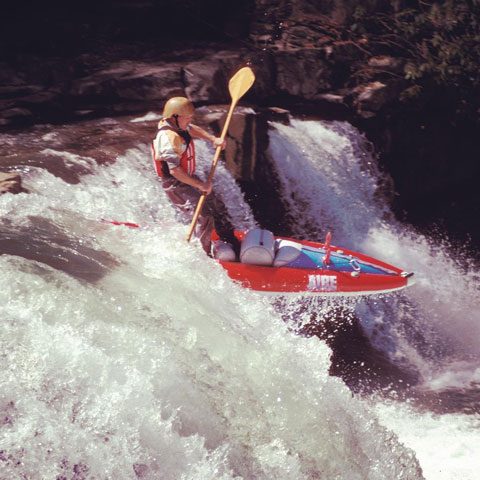
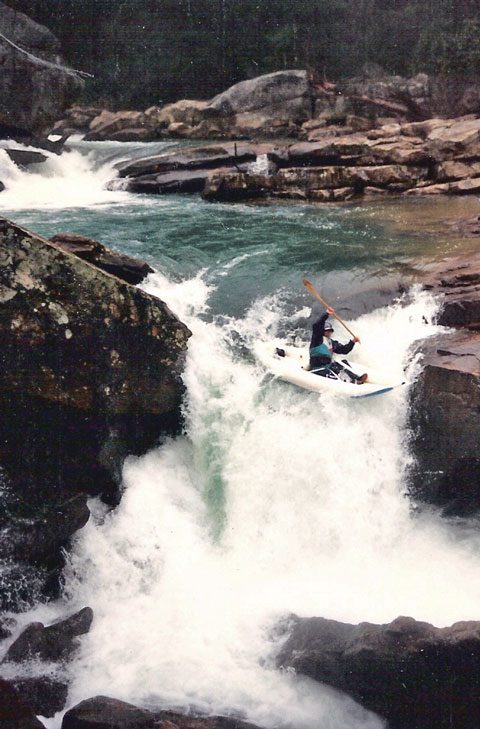
His brother Jeff Snyder went further by developing the strider boat: standing on the inflatable craft with a long kayak paddle to propel himself. He descends rapids and drops this way, much as stand up paddlers do today.
Inflatable kayaks — not just for beginners
Jim Snyder, a legend of American kayaking and inventor of the squirt boat, is a regular user of these Thrillseekers inflatable kayaks. A special nod to the purist kayakers who are a little too quick to dismiss anything inflatable on a river: yes, the greats manage just fine with them.
As Lionel Lafay kindly reminds me: "Inflatables are what save sailors as the very last resort!"
The same philosophy here
At Oueds & Rios, just as with the Snyder Brothers, it's all about "the wine, not the bottle". The Ubaye river, like many others, is a fabulous playground. Whatever the craft, experiencing these moments in this exceptional natural setting is a joy and a privilege. Everyone should have access to it — sharing that is our role.
On the Ubaye with Oueds & Rios
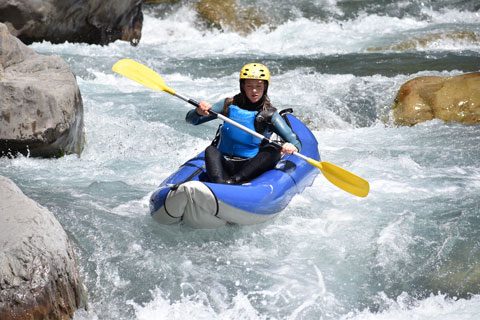
Paddling solo
The kayak-raft — or kaya-raft, airboat, kayak-air: whatever the name depending on the operator — is a robust, stable and unsinkable craft. At Oueds & Rios we use the term kayak-raft as it seems the most self-explanatory: "kayak-" refers to a solo craft paddled sitting down with a double-blade paddle, "-raft" describes its inflatable construction.
Its inflatable, flexible structure absorbs contact with rocks. It forgives the classic beginner's mistakes — not everything, but a great deal. A whitewater novice can run rapids straight away with no prior experience. This in no way removes the real dangers and hazards that exist on a river. At Oueds & Rios, every session is led by a qualified river guide who covers a few technical points before launching and provides, throughout the descent, instructional guidance and careful attention to everyone's safety.
Paddling in pairs
The cano-raft — or canoë-raft, hot-dog — is a two-person inflatable. You paddle kneeling with a single-blade paddle, in the canoe tradition. The kneeling position gives a higher vantage point over the river and a wider range of paddle movement.
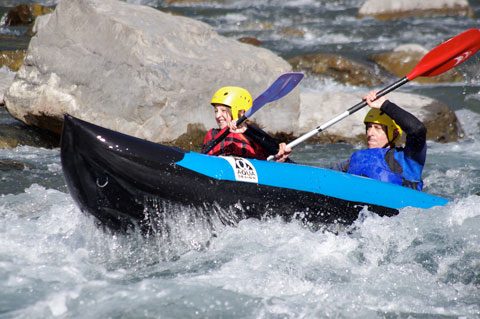
The hot-dog owes its nickname to the first Aqua Design / Mooving models — red and yellow, like a hot dog with mustard. Its behaviour on the water, twisting in every direction, made for genuine laughter. A hugely fun craft.
At Oueds & Rios, as a general rule, we use the term cano-raft as it tends to resonate best with people. If you choose to take on the adventure as a duo, we mainly offer this type of two-person craft for their stability and crew safety. Sitting with a double-blade paddle, both paddlers' centre of gravity is at its lowest, providing better stability than the kneeling position.
When you arrive at the base, we walk you through each craft, its strengths and limitations, to help you choose the one that best suits your profile and motivation.
Also read: Solo or duo kayak? [For couples]
Book a kayak session Learn more about kayaking 🎁 Give kayaking as a gift